
Halo: Combat Evolved came out in November of 2001, two months after the world changed in other ways. I bought it on launch day, drove home through a gray Wisconsin afternoon, and played the first three hours without standing up. I remember the flashlight on the ring, the first time I saw the Halo stretch up into the sky, the moment a Grunt squealed and ran away. Those memories are vivid, but they're not what I think about most now.
When I replayed Halo for this column, on an original Xbox connected to a CRT in my basement, I expected the combat to feel dated. I expected the level design to be repetitive. I expected the graphics to be rougher than memory allowed. What I didn't expect was how much the game would impress me with its restraint. Not the shooting — the silence. The way it uses space. The way it knows when to stop talking.
The question I asked before starting was the same one I always ask: does Halo still hold up? The answer surprised me. The combat is fine. The silence is extraordinary.
The Ring as an Idea, Not Just a Setting
The first thing Halo gets right is the opening. After a brief cinematic, you wake up on the Pillar of Autumn. You walk through corridors. You talk to soldiers. The game teaches you to look, to move, to shoot. Then you board an escape pod and crash onto the ring.
The moment you step out of the pod is one of the most quietly effective introductions in gaming. No music. No explosions. Just grass, trees, sky, and a waterfall. The ring stretches upward in the distance, curving across the sky like a band of polished metal. The sun is warm. The air feels clean. You've been inside a metal ship for an hour, and now you're outside, and the game lets you stand there and feel the difference.
This is the first lesson of Halo's restraint. It doesn't rush you. The Marines spread out, the Grunts arrive, the combat starts — but the game gives you a beat before all of that. It lets you look up. It lets you absorb the scale of the thing you're standing on. A modern shooter would open with a set piece. Halo opens with a view.
The Combat Loop That Changed Console Shooters
Let me talk about the combat, because it's still the thing most people remember. Halo's core loop — the gunplay, the grenades, the melee, the shield recharge — is often credited with inventing the modern console shooter. And that's true. The two-weapon limit, the regenerating shield, the dedicated grenade button — these became the standard for a generation of games. Replaying it now, the loop still works. It's clean and readable in a way that modern shooters often aren't.
The shield system is the key. In most shooters before Halo, health was a resource you managed. You had health packs, armor pickups, and a constant sense of scarcity. Halo changed that by giving you a shield that regenerated when you took cover. That one change rewired the entire pacing of combat. You could push forward, take damage, retreat, recover, and push again. The rhythm of engagement was now a flow, not a series of resource checks.
On this replay, I found myself slipping back into that flow immediately. Move forward, engage at range, close the distance, grenade, melee, retreat, recharge, repeat. The AI — especially the Elites — still feels alive in a way that surprised me. They dodge, they flank, they shout orders. The combat holds up better than I expected.
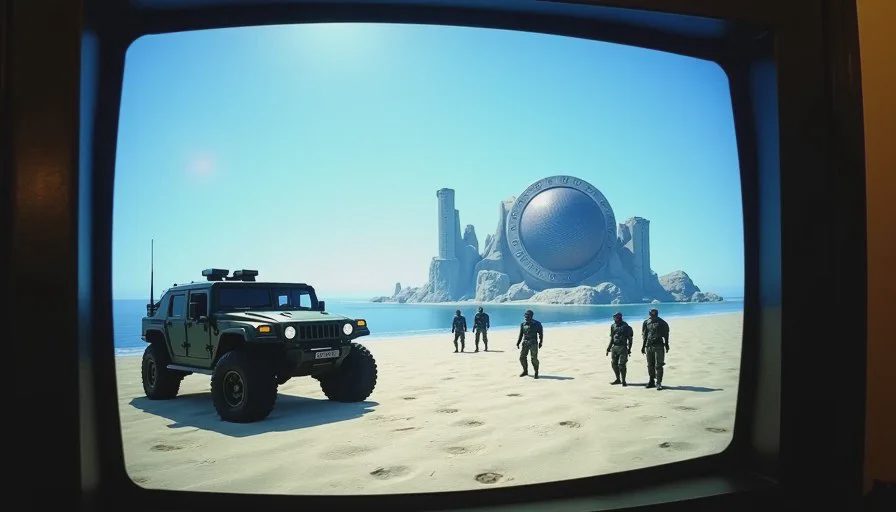
The Levels People Forget
Here's where I want to push against the common narrative. Halo is often criticized for its later levels — the Library, the Flood sections, the repeated corridors. And those criticisms are fair. The Library is genuinely tedious. The Flood are more annoying than scary. The second half of the game loses some of the openness that makes the first half so strong.
But the levels people forget are the ones that matter. The Silent Cartographer. Assault on the Control Room. These are the spaces where Halo's quiet genius shows through.
The Silent Cartographer is the best example. It's a level built around an island. You land on the beach, push inland, fight your way into a structure, and then — here's the key — you come back out. The level opens with you moving toward the island from a dropship, and it ends with you inside the island, looking back at where you came from. The spatial structure is circular, and it gives the whole level a sense of place that most shooters never achieve.
Assault on the Control Room is even quieter. It's a long, patient level built around a valley. You cross bridges, climb towers, and eventually reach a control room with a view that stretches back over everything you just traversed. The game lets you stand in that control room and look at where you've been. It doesn't need to tell you that you've come a long way. The space tells you.
Silence as a Design Tool
This is the thing I want to write about most, because it's the thing that still surprises me about Halo. The game understands silence in a way that almost no modern shooter does. It knows when to stop the music, when to clear the enemies, when to let you walk through a space with nothing but the sound of wind and your own footsteps.
The best example comes in the second level, after the first major firefight. You cross a bridge, and the combat stops. The music drops. The Marines chatter fades. You're alone on a hillside, looking out over the ring. The only sounds are the wind, the water, and the faint hum of the world. Nothing attacks you. Nothing rushes you. The game gives you a moment of pure presence.
That moment would not survive in a modern shooter. There would be a radio call, an objective marker, a NPC telling you where to go next. The silence would be filled. But Halo lets it breathe, and that breathing room is what makes the ring feel like a real place. You're not just moving through levels. You're standing in a world.

The Verdict: Still Quietly Extraordinary
So does Halo: Combat Evolved still hold up? The answer is yes, with caveats. The second half sags. The Library is a chore. The Flood are less interesting than the Covenant. The graphics, even on a CRT, are dated in ways that no amount of nostalgia can erase.
But the core of the game — the combat loop, the spatial design, the restraint — still works. More than works. It still teaches. Playing Halo now is a reminder that silence is a tool, that space is a language, and that a game can be confident enough to let you stand still and look at the sky.
Some classics survive contact with adulthood. Halo survives, not because it's the best shooter ever made, but because it understood something that most shooters have forgotten: the spaces between the fights matter as much as the fights themselves. The silence matters. The view matters. The moment when the music drops and the world opens up — that matters.
A game doesn't stay good just because you loved it first. Halo stays good because it was built around a simple, radical idea: let the player stand in the space and feel the scale of it. That idea still works. It works better than most of what came after.
I finished this replay at midnight, standing in the control room of Assault on the Control Room, looking out over the valley I'd crossed hours before. The music had stopped. The enemies were gone. The ring stretched across the sky, silent and vast. I stood there for a long time, and I understood why this game mattered then, and why it still matters now.
Some games are loud. Halo is quiet. And the quiet is the part that lasts.