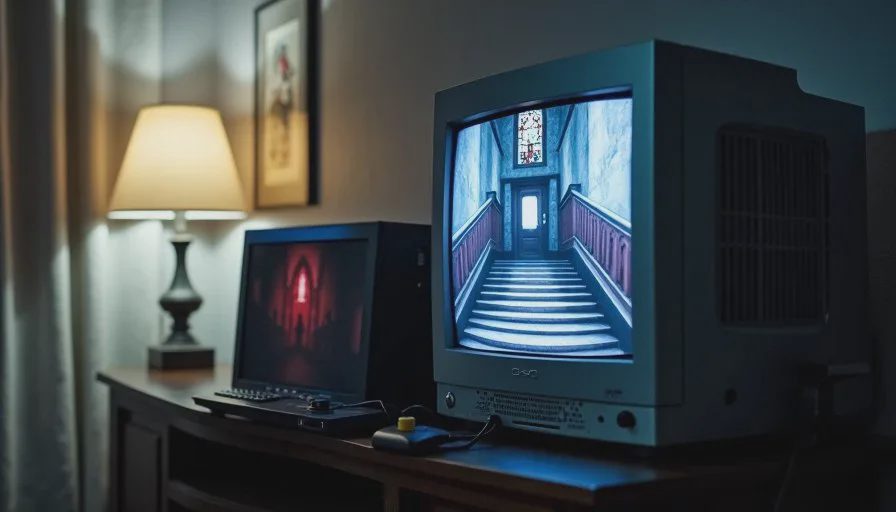
There are few games I'd call timeless without hesitation. The 2002 Resident Evil remake on GameCube is one of them. Not timeless in the sense that it plays like a modern game — it doesn't, and it never will. Timeless in the sense that it was built with such confidence and visual discipline that its age reads as intentional. It's less like a product of its era and more like a building designed to stand for decades. The question I asked before this replay was simple: does the Resident Evil remake still hold up, or am I just admiring the facade? The answer is more interesting than either option.
This is a game I've played at least once every few years since it launched. I know the Spencer Mansion well. I know its corridors, its locked doors, its item placements, its surprises. Knowledge changes the experience, but it doesn't flatten it. Each time I return, I notice something new about how the game is put together. This replay was no different.
The Visual Design Still Embarrasses Most Modern Games
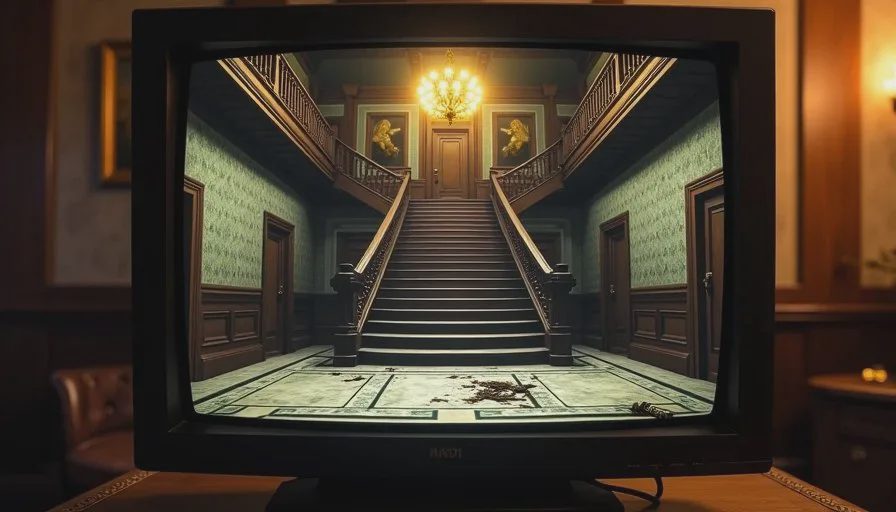
Let me start with the obvious, because it's the first thing every player confronts. The Resident Evil remake on GameCube is one of the best-looking games ever made, and it achieves that not through raw polygon counts but through visual restraint. The pre-rendered backgrounds are works of art. Every room is lit like a painting. Every surface has texture and weight. The mansion feels old, damp, decaying, and lived-in all at once.
The camera is fixed, and that's the key to the whole visual approach. Because the developers controlled exactly what you saw, they could compose each shot like a film frame. A doorway at the end of a hallway. A stained glass window casting colored light across a staircase. A corpse half-hidden in shadow. These images are burned into memory because they were designed to be — framed, lit, and staged with care.
On a CRT, the effect is almost unfair. The soft glow of the tube melts the pre-rendered backgrounds into something that looks closer to a film still than a game. On modern displays, the backgrounds can look slightly soft or flat, but on the screen they were made for, the illusion holds. This is one of those retro horror games that still holds up visually precisely because it didn't chase technical specs. It chased atmosphere.
The Tank Controls Are a Wall You Must Accept
Here's the part that divides every conversation about this game. The controls. The Remake uses the classic "tank controls" scheme: up moves your character forward in whatever direction they're facing, left and right rotate, and down steps backward. It's not intuitive by modern standards. It feels stiff, especially in tight spaces with fixed camera angles that shift between shots.
I understand why people bounce off this. The first thirty minutes are rough if you haven't played a game like this in years. You'll bump into walls. You'll struggle to line up with doors. You'll turn the wrong way while a zombie shambles toward you. It feels bad until it clicks.
But here's what I believe after multiple replays: the tank controls are not a flaw. They're a design choice that supports the game's entire philosophy. Resident Evil is not about mastering movement. It's about managing fear. The controls are deliberately heavy. They make you feel vulnerable. They turn every encounter into a decision — do I fight, or do I run, and can I execute either one cleanly enough to survive?
Once the controls click, they fade into the experience. You stop fighting them and start planning around them. That transition matters. It's the moment the game changes from a clunky relic into a tense, deliberate survival experience. If you never let that click happen, the game will feel broken. If you do, it feels like architecture.
Why Camera Angles Matter More Than Freedom
The fixed camera angles are another point of friction for modern players, but they serve a real purpose. The game uses the camera to control information. You can hear a zombie around the corner, but you can't see it. The camera shows you a long hallway from a low angle, and you hesitate because something might be waiting in the blind spot.
That hesitation is the game working as intended. Modern horror games often give you full camera control, which means you can always look wherever you want. That's more comfortable, but it also removes a specific kind of tension. The fixed camera makes the mansion feel like it's watching you. It gives the space a personality. The architecture itself becomes a participant in the horror.
The Crimson Head System Still Teaches a Lesson
The remake's most famous addition is the Crimson Head mechanic. If you kill a zombie and leave its body without burning it, the corpse will eventually rise again — faster, stronger, and far more aggressive. This one rule changes the entire game.
In the original 1996 Resident Evil, the optimal strategy was to kill everything and move on. Ammo was tight, but you could make it work. The remake punishes that approach. Every kill becomes a calculation. Do I have enough kerosene to burn the body? Do I have a clear path to avoid this zombie instead? Is it worth spending ammo at all?
The Crimson Head system forces you to engage with the game's spatial design. You learn which hallways you'll revisit and which rooms you'll pass through once. You memorize which zombies you've killed and which ones you've burned. The mansion becomes a map of decisions, and every decision has weight.
This is what I mean by the game aging like architecture. The Crimson Head system isn't just a gimmick. It's a structural change that reinforces the core fantasy of survival horror — that resources are finite, that danger lingers, and that the space itself remembers your choices.
What Doesn't Hold Up
I've spent a lot of time praising this game, and I stand by every word. But it's not perfect, and I don't want to pretend otherwise.
The inventory management is still tedious. The original game limited you to a small number of item slots, and the remake keeps that restriction. You'll spend a lot of time ferrying items between save rooms and objectives. Some players find this relaxing — a puzzle within the puzzle. Others find it exhausting. I land somewhere in the middle, but on this replay I felt the friction more than usual. When I have ninety minutes to play on a weeknight, I don't love spending twenty of them walking back to an item box.
The door animations are also still there. Every door between rooms triggers a loading sequence — a swinging door, a dark transition, the sound of hinges. It's atmospheric, and it builds tension, but it also eats time. The cumulative effect over a full playthrough is substantial. On a first run, you barely notice. On a fifth run, you notice.
The story is also gloriously dumb, and I mean that with affection. The dialogue is stilted, the characters are thin, and the plot is nonsense. But none of that matters, because the story isn't the point. The mansion is the point. The atmosphere is the point. The tension is the point. The writing is just the excuse.
The Verdict: Still Standing
Resident Evil remake is not a game you play for its controls or its story. It's a game you play for its structure — the way every system interlocks, the way the space is designed, the way the visual presentation creates a world that feels real and unreal at the same time. It's a game that knows exactly what it is and refuses to apologize for it.
On this replay, I finished the game in a little over ten hours. I used a guide for one puzzle I'd forgotten. I died twice. I jumped at least five times, including once at a moment I knew was coming. The game still works. Not because it's modern, but because it's built to last.
Some classics survive contact with adulthood. This one doesn't just survive. It thrives. It rewards patience. It respects your intelligence. It creates a place — the Spencer Mansion — that feels as solid as any real building I've ever been inside.
A game doesn't stay good just because you loved it first. The Resident Evil remake stays good because it was made with a craftsman's eye and a survivor's discipline. It's not just a game. It's architecture.