
Deus Ex came out in June of 2000, and I bought it on a burned CD from a friend of a friend because the local store had sold out. I installed it on a family PC that could barely run it, and I still finished it twice. The first time I played it like a shooter. The second time I realized the game was laughing at me for doing that. By the third run, years later, I understood what it actually was: a game that trusted the player to think. That kind of trust was rare in 2000. It's rarer now.
So when I sat down to replay it for this column, the question wasn't whether Deus Ex was important. It clearly was. The question was whether it still works as a game in 2026. Does it hold up, or is it one of those old PC games that still feel good only if you're willing to excuse a mountain of clunk? The answer is complicated, and more interesting than either extreme allows.
The First Hour Feels Like a Different Era
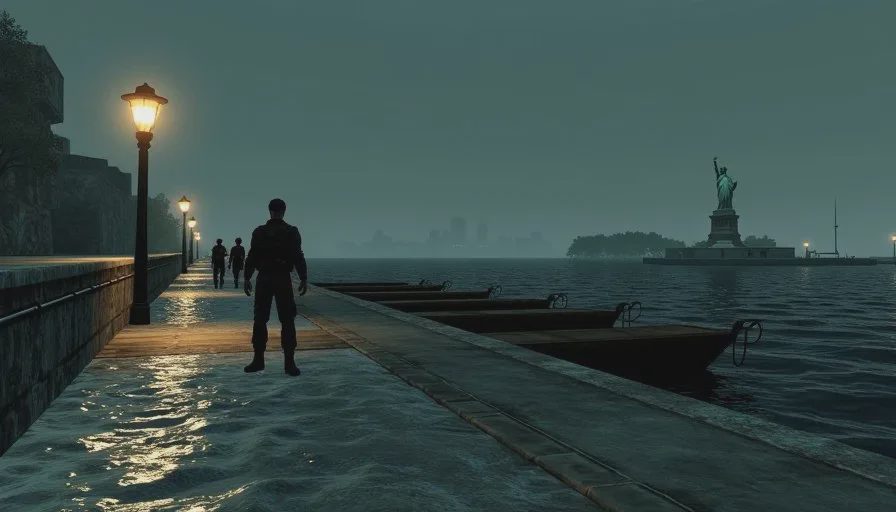
Deus Ex opens with a long cinematic intro, then drops you into a dimly lit dock on Liberty Island. You have a pistol, a prod, a lockpick, and a conversation waiting for you with your brother Paul. The first thing the game does is let you choose how to enter the Statue of Liberty. You can shoot your way in. You can sneak. You can hack a turret and let it do the work. You can talk to people, explore the docks, find alternate routes, or just walk in through the front door and start swinging.
That opening hour is still remarkable. Not because it's polished — the animation is stiff, the voice acting is uneven, the AI is primitive — but because it establishes the game's core contract immediately: the game will present a problem, and you will decide how to solve it. The toolset is yours. The mission is fixed, but the method is not.
On this replay, I did something I'd never done before: I avoided killing anyone on the first level. Not because the game asked me to, but because I wanted to see if it would notice. It did. Characters commented on my restraint later. That's the thing Deus Ex does that still feels ahead of its time. It tracks your behavior quietly, and the world responds to it, but it never tells you which choices mattered or how the systems were scoring you.
The Systems Are Still the Show
Let me be clear about what makes Deus Ex special, because it's easy to forget in an era where every game claims to offer "player choice." Deus Ex doesn't offer choice through branching dialogue trees or moral parrots. It offers choice through overlapping systems.
The skill system, the augmentation system, the inventory, the damage model, the AI states, the lighting, the sound propagation — all of them interact. A locked door can be picked, hacked, blown open, bypassed via a vent, or avoided entirely if you find another route. A guard can be shot, stunned, distracted, avoided, or turned into an ally through a hacked turret. The game doesn't signpost these options. It just builds a world dense enough that options exist.
On this replay, I leaned into the hacking and electronics skills, which I'd mostly ignored in my younger runs. I turned turrets against their owners. I opened safes with multitools instead of searching for keys. I read emails I'd never seen. And the game rewarded me with small narrative payoffs — a password, a warning, a character who mentioned something I'd done off the critical path. That density is still impressive.
The comparison I kept returning to while playing was a modern blockbuster with skill trees. Most modern games use progression systems as content gates: you unlock a thing so you can do the thing the level requires. Deus Ex uses its systems as language. You learn to speak in hacks, lockpicks, silenced shots, and social manipulation, and the game becomes a conversation.
The Clunk Is Real and It Is Everywhere
Now for the part I can't ignore. Deus Ex is clunky in ways that will test any modern player's patience, and I say that as someone who loves the game.
The shooting is bad. Not "retro charm" bad. Just bad. Your weapon sway is tied to skill points, so at low skill levels you'll fire a pistol and watch the bullet trail miss by a full foot. The assault rifle feels weightless. The shotgun works only at point-blank range. The sniper rifle, with enough skill and accuracy mods, is the only gun that feels decent — but you have to invest to get there, and the early hours punish you for not knowing which skills matter.
The AI is primitive by any standard. Guards patrol fixed paths. They react to noise, but not intelligently. They'll run into walls, fail to notice a body at their feet, and occasionally forget you exist mid-firefight. That's not charming. It's just the reality of 2000-era systems.
The graphics are harsh on modern hardware. The Unreal Engine 1 look — all sharp geometry and muddy textures — reads worse on a 4K screen than it did on a 15-inch CRT. You'll want to play this one on older hardware or with a mod that at least fixes the resolution and texture filtering. Some old PC games that still feel good visually — Deus Ex is not one of them without help.
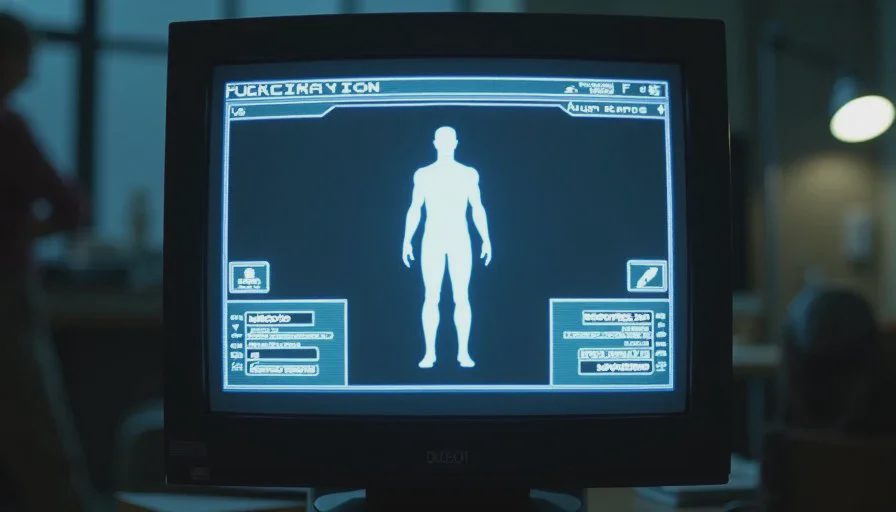
The voice acting is a mixed bag, and the lip-sync is comically bad. The pacing of the first act is slow. The inventory management is fussy. The aug interface is a wall of icons that takes time to learn. None of this is fatal, but all of it adds friction. If you're new to the game and expecting a smooth experience because of the reputation, you will be disappointed for the first few hours.
The Story Has Aged Better Than Most Games From 2000
Here's where Deus Ex earns its keep. The story is about terrorism, surveillance, global inequality, artificial intelligence, and the concentration of power — and it reads more relevant now than it did when it was written. The game has a specific paranoid texture. You spend the early missions chasing a shadowy conspiracy, and the game lets you discover that the conspiracy is both real and more complicated than you thought.
The writing is dense. Emails, newspapers, data cubes, overheard conversations — the worldbuilding is delivered through texts and voice logs, and it's better than most modern equivalents. There's a level of political cynicism in the writing that felt edgy in 2000 and feels almost documentary in 2026.
The plot has its share of late-'90s conspiracy-thriller cheese, and the ending choices have been debated for two decades. But the game never condescends to you. It assumes you're smart enough to follow the threads, and it doesn't resolve everything with a cutscene. That respect for the player is the rarest thing in game storytelling, and it's still rare today.
The Hong Kong Section: Still a Masterclass in Structure
If there's one part of the game I'd point to as proof of its greatness, it's the Hong Kong section. You arrive in a city that's fully explorable, with two rival factions, multiple side quests, a black market, and a main path that can be approached from any angle. The game gives you a set of problems — a missing person, an occupied compound, a hostile police force — and then turns you loose.
I spent three hours in Hong Kong on this replay, and I didn't touch the main objective for the first two. I did a side job for a gang leader, found a hidden back entrance to the compound, and learned more about the world from emails than from any cutscene. That stretch of the game, more than any other, demonstrates what Deus Ex could do when all its systems were firing. It's one of the best single-city sections in PC gaming, and it still works.
The Verdict: A Masterpiece With a Learning Curve
The honest take is this: Deus Ex is a clunky masterpiece. The clunk is undeniable — the shooting, the AI, the graphics, the interface. If you need games to feel good in the moment, moment by moment, Deus Ex will frustrate you. That's not a small caveat. It's a real barrier.
But if you can get past the surface, the game underneath is still one of the most intelligent, ambitious, and respectful things the medium has ever produced. It treats player choice as a structural principle, not a marketing bullet point. It builds a world dense enough to reward curiosity. It trusts you.
When I finished this replay, I closed the game and sat for a few minutes, thinking about all the things I'd found that I'd missed twenty years ago. That's the mark of a real classic. Not that it's smooth, but that it's deep enough to still surprise you.
Deus Ex is not a game I'd recommend to everyone. But if you care about game design, about player agency, about what the medium can do when it stops holding your hand, then yes — it's still the real thing. It's a game you respect more than you enjoy, and it will make you think differently about everything that came after it.
A game doesn't stay good just because you loved it first. Deus Ex stays good because it earned it.