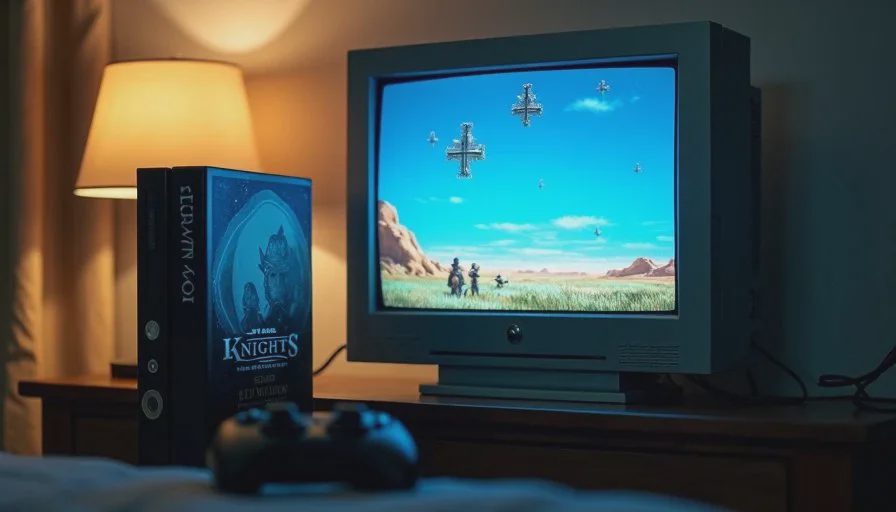
Knights of the Old Republic came out in the summer of 2003, and I bought it the day it hit shelves for the original Xbox. I'd been a Star Wars kid my whole life — I had the action figures, the posters, the worn-out VHS tapes of the original trilogy — but this was something different. This wasn't a game about Luke Skywalker or Darth Vader. It was a game set four thousand years before any of that, in a version of the galaxy I'd never seen, with original characters and a story that promised to be as much about choice as about lightsabers.
I played it obsessively for two weeks. I finished it at three in the morning on a school night, watched the final dialogue play out, and sat in the dark feeling like I'd been through something real. That game mattered to me. The question now, more than twenty years later, is whether it still deserves the time it asks for. Because it asks for a lot. This is a thirty-plus-hour RPG with dense systems, long dialogue trees, and a combat engine that was already controversial in 2003. Replaying it as an adult with limited free time is a different test entirely.
The Opening Hours Still Set the Hook
KOTOR opens with a cold, efficient introduction. You're on a Republic ship under attack by Sith forces, you don't know who you are, and the game wastes no time throwing you into a tutorial that doubles as a story setup. The Ebon Hawk escape, the crash on Taris, the slow realization that you're stranded on a planet that's about to get much worse — it's a tight opening that establishes the stakes without drowning you in lore.
On this replay, what struck me most was how quickly the game gives you meaningful choices. Not cosmetic choices, not dialogue options that all lead to the same outcome — real decisions that shape your character and your relationships. By the time you leave Taris, you've already made at least three decisions that will echo through the rest of the game. That's rare, even now.
Taris itself is the game's most controversial section. It's long, it's dense, and for a first-time player it can feel like the game is stalling. I remember thinking, back in 2003, that Taris was an odd choice for an opening — it's almost entirely urban, with no lightsabers, no Jedi powers, and no real sense of the larger galaxy. But on this replay, I found myself appreciating it more. Taris is the game teaching you to live in its world before it gives you the keys to the kingdom. It's the patience before the payoff.
The D&D Combat Is a Wall You Have to Climb
Here's the part that tests adult patience the most. KOTOR runs on a modified version of the Dungeons & Dragons d20 system, which means combat is real-time with pause, but the underlying math is turn-based. You queue up actions, watch them play out, pause to issue new orders, and repeat. It's not flashy. It's not fast. And by modern standards, it feels deeply unintuitive.
The problem isn't the math. The problem is the feedback. When you attack an enemy, the game rolls a virtual d20 behind the scenes. If you miss, you see a little text popup — "Miss" — and your character swings at the air. If you hit, the damage number floats up. It's functional, but it's not satisfying. There's no impact, no weight, no sense that your button presses are doing anything. The combat feels like watching a spreadsheet calculate itself.
On this replay, I leaned into the pause function. I set the game to auto-pause at the start of every combat round, issued my orders carefully, and treated the fights like a tactical puzzle rather than an action game. That made it bearable. But it also highlighted how much friction the game puts between you and the parts that actually matter — the story, the characters, the choices. I respect the D&D heritage. I just don't think it translates well to a game that wants to be cinematic.
What the Combat Gets Right
It's not all bad, and I want to be fair. The d20 system has one big advantage: build variety. The way you distribute your attributes, skills, and feats genuinely changes how the game plays. A Force-focused build plays differently from a melee-focused build, which plays differently from a blaster-focused build. The game rewards specialization, and the choices you make at level-up matter.
The Force powers are the best part. Once you become a Jedi — and the game makes you wait for it — the powers open up dramatically. Force Persuade lets you bypass entire combat encounters. Force Lightning turns you into a walking storm. Force Choke is as satisfying as it sounds. The combination of Jedi powers, party composition, and tactical pause gives the combat a layer of depth that's easy to miss if you just mash attack.
The Writing Is Still the Real Star
Here's where KOTOR earns its reputation. The writing is exceptional, and it's held up better than almost any other part of the game. Not just the dialogue — though the dialogue is sharp — but the structure of the story, the pacing of the reveals, and the way the game builds toward its most famous moment.
I won't spoil it here, even though the twist is one of the most famous in gaming history. What I'll say is this: the twist works because the game has been quietly laying the groundwork for it the entire time. Every conversation, every choice, every strange moment of deja vu — it all means something. When the reveal lands, it recontextualizes everything you've done up to that point. That's not just good writing. That's good architecture.
The companion characters are the other pillar of the writing. Bastila's conflicted Jedi duty. Carth's paranoia. HK-47's murderous comic relief. Mission's scrappy loyalty. These characters are archetypes, but they're written with enough specificity to feel like people. And the game lets you build real relationships with them — some of which can shift based on your alignment and choices. That was rare in 2003, and it's still rare now.
What the Game Asks From You
So does KOTOR still deserve the time commitment? The honest answer depends on what you're willing to give it.
The game is long. A focused playthrough runs thirty to thirty-five hours. A completionist run can stretch past forty. That's not a problem if the hours are well spent. But KOTOR has stretches that drag — the Taris opening, the mid-game planet-hopping, the long corridors of the Star Forge. Some of that length is earned. Some of it is just era-appropriate padding.
The technical limitations are also real. The game looks rough on modern displays. The character models are stiff, the animations are wooden, and the environments — while imaginative — show their age. Playing on an original Xbox with a CRT helps, but the game still feels like a product of 2003. The audio, on the other hand, is still wonderful. The music, the sound design, the iconic ambient hum of a Star Wars spaceport — it all still works.
The Verdict: A Time Commitment With Real Returns
When I set out to replay KOTOR for this column, I genuinely didn't know what the answer would be. I remembered it as a masterpiece, but I've been burned by memory before. Some games that meant everything to me at twenty-two don't survive contact with forty-one. I expected KOTOR to be one of them.
It wasn't. The combat is clunky, the pacing sags in places, and the technical limitations are impossible to ignore. But the writing, the characters, the structure, and the choices — they still carry the game. KOTOR is a rare thing: a licensed game that respects its source material while doing something genuinely original with it. It trusts you to care about its world, and that trust pays off.
If you have thirty hours to spare, KOTOR is still worth them. Not as a nostalgia trip, but as a reminder of what RPG storytelling can do when it takes the player seriously. It's a game that asks for your time and actually gives something back.
Some classics survive contact with adulthood. Some don't. Knights of the Old Republic survives — with the lights on, the soundtrack swelling, and a story that still knows exactly what it's doing. That's not something every old game can claim. It's something this one earned.
A game doesn't stay good just because you loved it first. KOTOR stays good because it was built to last — and because, twenty years later, it still deserves the time it asks for.