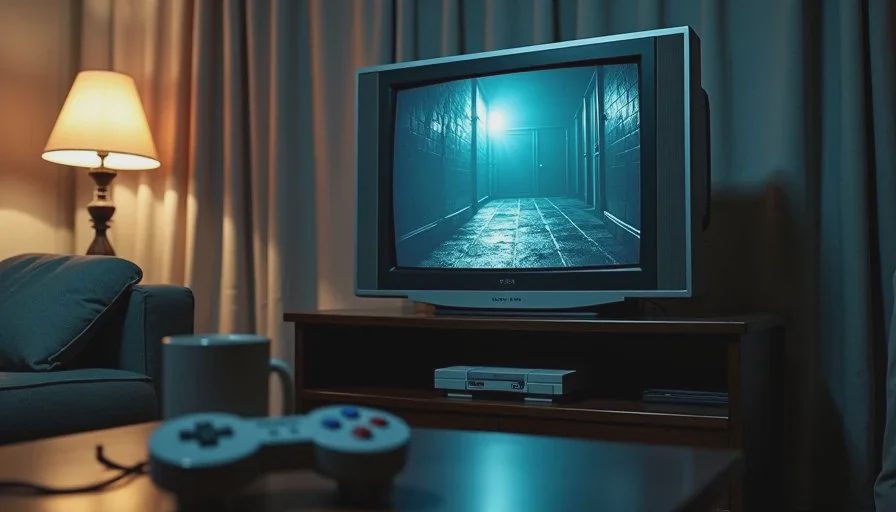
I've spent the last two years slowly rebuilding a corner of my basement into a late-'90s time capsule. Nothing elaborate — a 21-inch Sony Trinitron, a PS1, a SNES, a Dreamcast, and a shelf of games I actually play, not just display. Friends who visit fall into two camps. The first camp says, "That's cool, but can't you just emulate all that?" The second camp sits down, watches the screen for thirty seconds, and goes quiet. The second camp gets it.
Here's the thing I've learned from hours of testing: a CRT changes the mood of a game more than people admit. Not in a subtle, audiophile-on-a-podcast way. In a real, measurable, sensory way that affects how you play, how you feel, and whether an old game still lands the way it did when you were young. This isn't just nostalgia talking. It's physics, design intent, and a little bit of psychology.
The Flawed Assumption: Old Games Were Designed for New Screens
The biggest mistake retro gamers make is assuming an old game will look "correct" on whatever screen happens to be in the house. That assumption is wrong. Games from the SNES, Genesis, PS1, Saturn, and Dreamcast eras were built by developers staring at CRTs. They tuned their art around how a tube display renders an image — the glow, the scanlines, the slight blur, the way colors bleed into dark areas.
A modern flat panel displays pixels as hard-edged squares. A CRT draws the image as an electron beam sweeping across phosphors. That difference sounds technical, but the visual result is enormous. Pixel art designed for CRTs often relies on the tube's natural blending to create shading and depth. Take a sprite from a 16-bit game and blow it up on a 4K monitor, and you'll see a grid of blocks. Put that same sprite on a CRT, and the edges soften, the colors merge, and suddenly the character looks like a character, not a spreadsheet.
This is why so many retro game screenshots on modern displays look harsher than you remember. You're not misremembering. The game was never meant to look that sharp.
What a CRT Actually Does to the Image
Let me break down the specific effects, because they all contribute to the mood of a game.
Scanlines Do More Than Add Texture
Scanlines are the most obvious CRT signature — the thin dark lines between rows of illuminated phosphor. People tend to think of them as a decorative filter, something you toggle on in an emulator to feel retro. But on a real CRT, scanlines aren't a filter. They're structural. They create a natural grid that organizes the image, reduces perceived pixelation, and gives solid areas of color a subtle rhythm.
This matters most in dark scenes. On a flat panel, a dark corridor in Resident Evil or Silent Hill can look like a uniform gray-black smear with blocky textures. On a CRT, the same corridor has depth. The scanlines break up the darkness, the phosphor glow lifts certain details forward, and the image feels like it exists inside the screen rather than being pasted on top of it.
I did a side-by-side test with Silent Hill 2 on a PS2, switching between a 2005-era LCD and the Trinitron. The difference was startling. On the LCD, the fog looked like a gray gradient and the flashlight beam looked clipped. On the CRT, the fog had layers, the beam bled naturally into the dark, and the whole scene felt heavier. The game wasn't prettier in a technical sense. It was more atmospheric in a way that's hard to describe unless you see it.
Color Bleed and Phosphor Glow
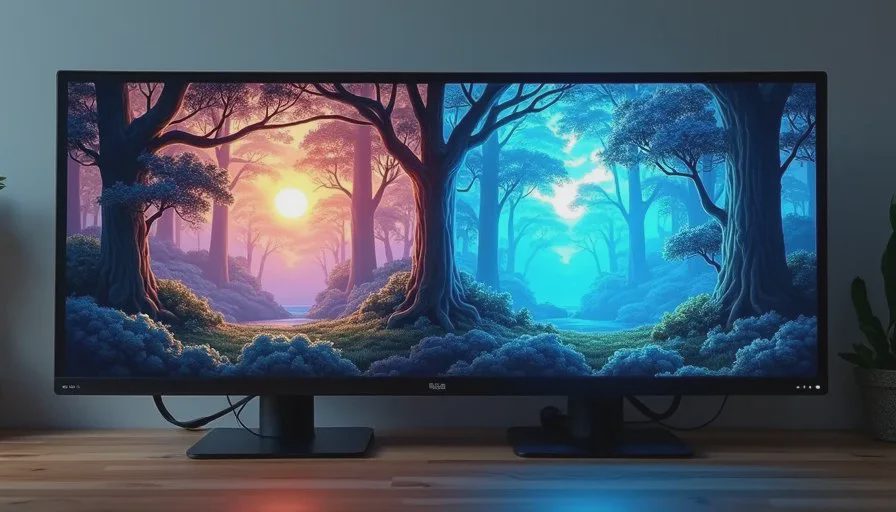
CRTs don't display color the way modern panels do. The phosphors glow, and that glow spills slightly beyond its intended pixel. This is called color bleed, and while it sounds like a flaw, it's actually one of the reasons old games looked warmer.
A red health bar on a CRT has a soft halo around it. A neon sign in a cyberpunk scene radiates into the surrounding darkness. Skin tones blend instead of banding. The overall effect is more forgiving, more organic, and closer to film than to a computer display.
When I first started taking retro game photos and videos, I assumed the washed-out look on a CRT was incorrect. Then I went back and looked at promotional screenshots from the '90s in old magazines. They had the same softness. The CRTs weren't wrong. The modern display standard was just never the target.
Motion Clarity That Feels Different
Here's a part people don't talk about enough: motion. CRTs refresh the entire image every frame, and they do it nearly instantaneously. There's no sample-and-hold blur like you get on most LCD and OLED screens. When a side-scrolling game moves, the background stays clear. When a 3D camera rotates, the world doesn't smear.
Old games were built around this motion behavior. A fast 2D platformer like Sonic the Hedgehog or a 60fps racing game like Ridge Racer depends on crisp motion to feel responsive. On a modern display without proper handling, those games can look blurry and feel laggy. On a CRT, they snap. The mood changes because the game feels more immediate, more alive.
Input Response You Can Feel
There's also the input lag question. A well-tuned CRT has near-zero display lag. A modern TV, even in game mode, adds processing time. It might be a frame or two. For a slow RPG, it doesn't matter. For a rhythm game, a fighting game, or a tight platformer, it changes everything.
I noticed this most with Super Mario World. I've played that game hundreds of times, on dozens of devices. On the CRT, the jump feels like an extension of my thumb. On a modern TV, even with a good scaler, there's a tiny disconnect that I can't un-feel. It's not a dealbreaker, but it's real. And that tiny disconnect shifts the mood from "I'm inside the game" to "I'm controlling the game from outside."
The Dark Room Factor
Here's the part that's hardest to explain in a spec sheet. A CRT in a dark room has a presence that a flat panel doesn't. The tube glows. The glass reflects faintly. The screen isn't just a light source — it's an object with weight and depth. The slight curvature of the tube gives the image a soft dimensionality that modern flat screens lack.
When I play retro horror on a CRT, the experience feels more enclosed. The darkness of the room merges with the darkness on screen, because the black levels on a CRT aren't true black — they're a deep phosphor glow that feels alive. This is one reason retro horror on CRT has become a kind of subculture. Games like Silent Hill, Resident Evil, and Fatal Frame were built around the assumption that the player would be sitting in a dim room, close to the screen, with the glow creating its own sense of place.
A modern OLED can produce perfect black, but that's a different feeling. Perfect black is clean and isolating. CRT black is fuzzy and atmospheric. It invites you in instead of pushing you out. If you've never tried it, I recommend it — not because it's "better" in a technical sense, but because it changes the way the game feels in your body.
The Practical Side: What You Need to Know
If you're curious but don't want to become a CRT collector, here's the honest guidance.
Start small. A 13 to 20-inch consumer CRT is cheap, often free on marketplace listings. Look for one with component or S-video inputs, because composite is muddy even by CRT standards.
Don't chase perfection. You don't need a broadcast monitor. A decent consumer Trinitron or JVC with a healthy tube is more than enough to see the difference. The goal isn't perfection — it's atmosphere.
Set it up in a room you actually use. If the CRT lives in a storage closet, you'll never play it. Put it in the corner of a living room or office, and make it easy to turn on.
Accept the maintenance. CRTs are old. They can buzz, they can drift, and they can die. Most issues are simple — degaussing, geometry tweaks in the service menu — but if you're not comfortable poking around inside a tube, don't. Just enjoy it while it works.
The Mood Is the Point
I started this piece by saying a CRT changes the mood of a game more than people admit. After writing all of this, I'd go further. The CRT isn't just a display. It's part of the game's original instrument. The developers composed for it. The art was tuned to it. The darkness, the glow, the scanlines, the motion — they're not accidents. They're the intended texture.
When you play an old game on a modern screen, you're hearing a song through a different speaker. It might be cleaner. It might be sharper. But it's not the same song. If you care about retro game atmosphere — about what these games actually felt like when they were new — then a CRT is not a nostalgia prop. It's a piece of the experience.
Some classics survive contact with adulthood. But a lot of them survive better when you give them back the screen they were made for.