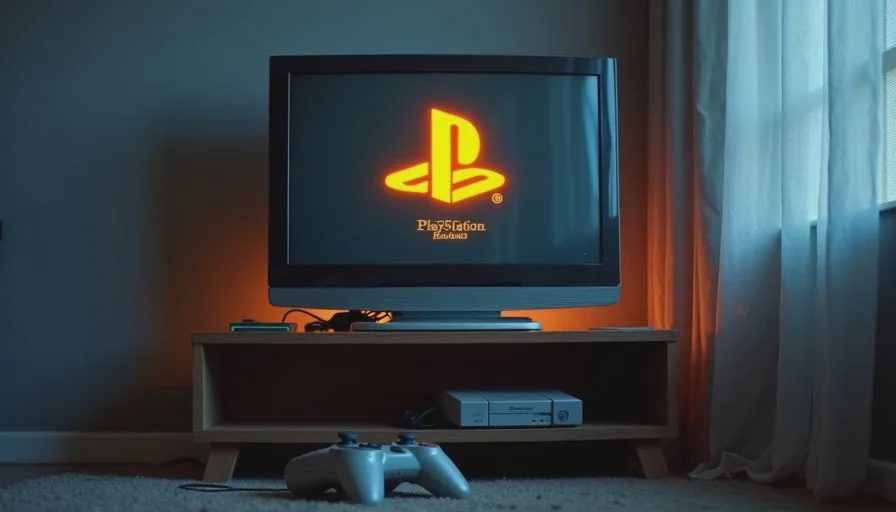
There's a moment before the game starts. Not the title screen, not the opening cinematic — the moment before all of that. The console powers on, the screen flickers, and a logo appears. Maybe it's the orange diamond of the PlayStation, the chime of the GameCube, the spinning Sega logo on the Dreamcast. It lasts three seconds, maybe five. We used to ignore it. Now I catch myself waiting for it.
This column is called Living Room Static, and it's about the analog textures of retro gaming — the physical and sensory details that shaped how old games felt. Boot screens, disc swaps, and loading chimes are part of that. They were friction once, small obstacles between intention and play. Now they feel like ritual. The question is why.
What We Lost When Loading Got Fast
Modern games load fast. That's a genuine achievement. We have SSDs that eliminate load times, quick-resume features that drop you into a game from a cold boot in seconds, and digital libraries that never ask you to stand up. I use all of it. I don't want to go back to waiting fifteen seconds every time I enter a room.
But something got lost in the transition, and it's not just time. The pause itself had a function. It created a boundary.
When a PS1 game loaded, you heard the drive spin up. The screen would go black for a moment, or display a static image with a progress bar or a spinning symbol. That pause separated the world from the game. It told you something was about to happen — that the machine was working, that the disc was being read, that a space was being assembled. The friction was part of the threshold.
Modern games have almost eliminated thresholds. You press a button and you're in. That's convenient, but convenience has a flattening effect. When every game starts instantly, they all start to feel the same. The boot screen was a handshake. The loading chime was a doorbell. These small ceremonies told you where you were and what you were about to do.
Boot Screens as Identity
Let me be specific, because I think the details matter. The original PlayStation boot screen is a two-part experience. First, the orange diamond logo on a black background with a deep, synthesized chime. Then a second logo screen, white with a blue background, confirming the system is reading the disc. That transition — black to orange to white — is burned into the memory of anyone who grew up with the console.
The GameCube had a different approach. The boot screen was playful. A cube would drop onto the screen, bounce, and then the logo would form while a small chime played. If you held the Z button while the system started, the sound would change. That was a secret, and knowing it felt like being part of a small club.
The Dreamcast had the most atmospheric boot screen of the generation. A glowing orange spiral on a white background, accompanied by a soft ambient tone. It was strange and beautiful, and it told you immediately that this console was different. The boot screen itself was a kind of art statement.
These moments were not gameplay. They weren't story. They were threshold rituals — small ceremonies that prepared you to enter a world. And because they were tied to specific hardware, they became part of the identity of the games themselves. A PS1 game didn't feel the same on a PS2. The boot screen changed. The ritual changed. The game changed with it.
Disc Swaps and the Physicality of Play
The disc swap is the most obviously dated ritual, and I understand why no one misses it. Multi-disc games on the PS1 — Final Fantasy VII, Chrono Cross, Metal Gear Solid, Grandia — required you to physically stop, eject the tray, remove one disc, insert another, and wait for the system to verify it. If your hands were greasy from snacks or if the disc had a scratch, you worried. The swap was a vulnerable moment.
But the swap also had meaning. It marked progress. When Final Fantasy VII asked you to insert Disc 2, you had crossed a threshold in the story. You were now in the second act. The physical action mirrored the narrative structure. That's rare now. A digital download has no texture, no weight, no moment of transition. You can be sixty hours into a game and never touch the hardware that runs it.
I'm not arguing we should bring back disc swaps. I'm arguing that something was lost when the game stopped being a physical object. The swap was a reminder that the game existed in the world — that it was a thing you held, a thing that could be scratched or lost or lent to a friend. The ritual grounded the experience in physical reality. Modern gaming is smoother, but it's also more abstract.
Loading Chimes and the Sound of Waiting
The loading chime is a more subtle texture. Some games had music during load screens. Others had a simple animation with a sound effect. The PS1's CD reading produced a distinctive mechanical whir, soft but audible, that you'd hear every time the game accessed data. On a quiet night, that whir was part of the soundtrack.
I remember playing Resident Evil 2 late at night in the summer of 1998. The door-opening loading screen had its own sound — a low creak, then a soft thud as the door settled. Every loading door reinforced the game's atmosphere. You weren't just waiting. You were listening. The creak became Pavlovian. You heard it and your shoulders tightened, because you knew something might be on the other side.
Modern loading is silent. A progress bar fills, a spinner rotates, and the game resumes. It's efficient, but it's also empty. The loading chime gave the wait a texture. It told you the machine was alive, that the game was working, that something was arriving. The silence of modern loading feels like a small absence.
Why These Textures Still Matter to Adults
I've thought a lot about why these old textures affect me more now than they did when I was young. When I was a teenager, the boot screen was just something to sit through. The disc swap was a hassle. The loading chime was background noise. I wanted to get to the game.
Now, as an adult with limited time, I find myself lingering on these moments instead of rushing through them. The pause before the game starts has become part of the experience. It's a small pocket of anticipation. A moment where the day falls away and the game world begins to assert itself.
Part of this is memory. The PlayStation boot chime doesn't just mean the console is starting. It means 1997, a friend's basement, a rented disc, a Saturday afternoon with no obligations. The texture carries the context. When I hear it now, I'm not just powering on a console. I'm opening a door to a younger version of myself.
But it's not all nostalgia. These rituals have a genuine aesthetic function. They create anticipation. They build atmosphere. They establish mood before the game has a chance to. A modern game has to work harder to create that transition, because the technology no longer provides it for free. The boot screen did work that was more than technical. It was emotional.
The Case for Slowing Down
I'm not asking anyone to abandon emulation or stop using fast loading. I use modern conveniences constantly. But I think there's a case for slowing down occasionally, for preserving these rituals where they still exist, and for noticing them when they appear.
When I play a PS1 game now, I don't skip the boot screen. I wait for the chime. I listen to the drive spin up. I let the loading screen play out. These are not wasted seconds. They're part of the experience — the threshold, the anticipation, the ritual of entering a world.
Some old games survive contact with adulthood. Some don't. But the textures around the games — the boot screens, the disc swaps, the loading chimes — they survive too. They've become a strange comfort, a kind of sensory shorthand for everything this hobby used to be.
The strange comfort of boot screens and loading chimes is real, and it's earned. It's not just that we're nostalgic for the past. It's that these sounds and pauses still do something to us. They slow us down. They mark the transition. They remind us that a game is not just content — it's a place you enter, a ritual you perform, a world that asks for your attention before it gives anything back.
And in a world that increasingly refuses to pause, that may be the most valuable thing a loading screen has to offer.